
Short answer: PEEK is a semi-crystalline polymer, but a PEEK tube is not automatically crystalline. Depending on how it is extruded, the same resin can come off the line fully amorphous, fully crystalline, or somewhere in between, and every property on the datasheet moves with it. For medical tubing, fully crystallized should be the default. Amorphous PEEK should be a deliberate choice, made only for a specific reason.
This is one of the least understood parts of specifying PEEK extrusions, and it causes problems long after a part has passed inspection. Below is what crystallinity changes, what the test data shows, and how to check what you are actually getting. Everything here comes from the white papers Jonathan has published on the subject (sources at the end).
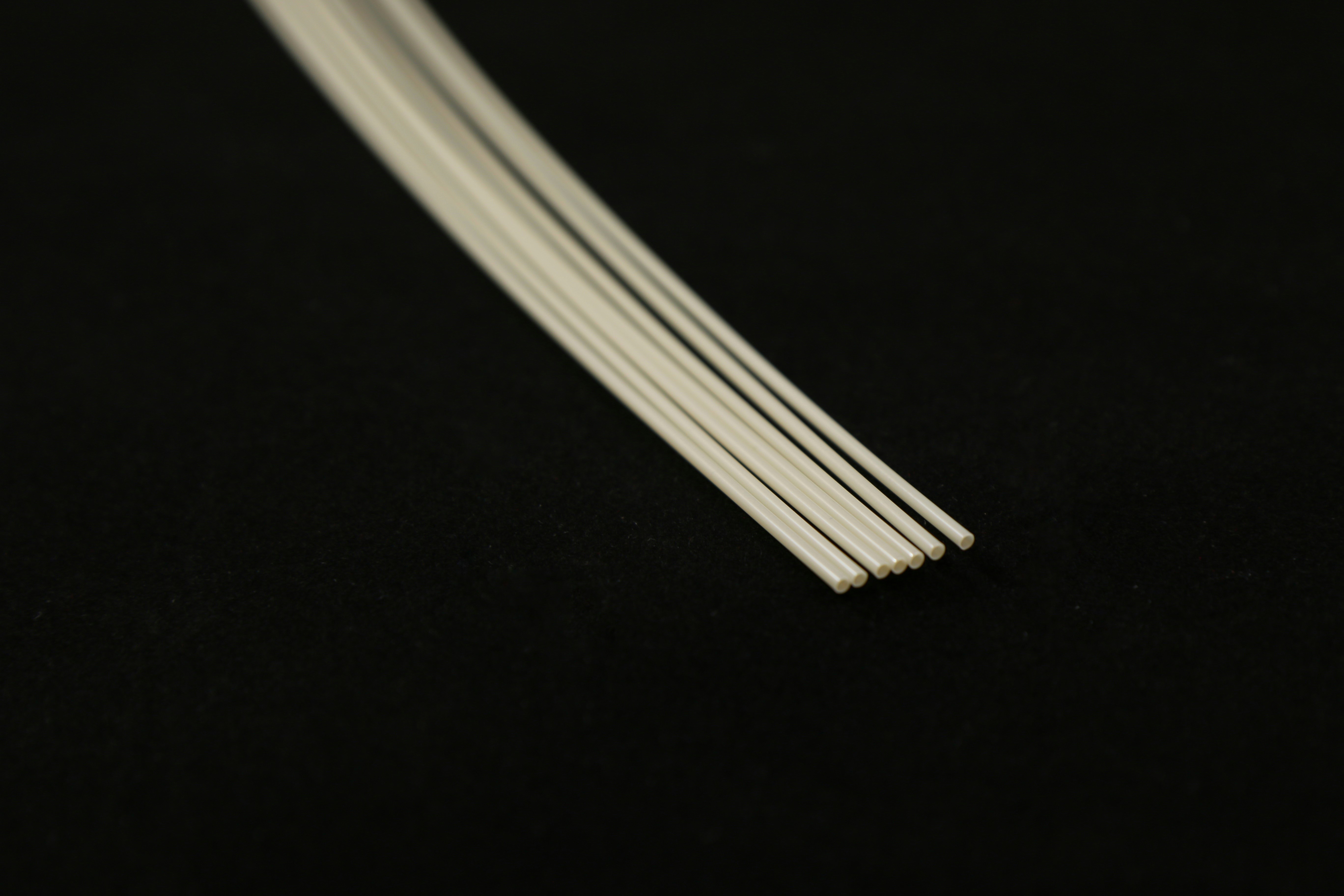
What "Semi-Crystalline" Means for a Tube
In a semi-crystalline polymer, a portion of the molecules align and form crystals while the rest stay amorphous. In PEEK, the bonds in those crystalline regions are strong and take a lot of energy to loosen. That structure is where PEEK gets its chemical resistance, its high-temperature stability and its stiffness.
The catch is that PEEK's crystals have to be allowed to grow. Some semi-crystalline materials, such as acetal, HDPE and polypropylene, fully crystallize regardless of processing method. PEEK does not. Cool it too fast and it freezes in an amorphous state before it reaches its semi-crystalline structure. Getting to full crystallinity takes either specialized in-line processing or a secondary operation.
The Datasheet Assumes Full Crystallinity
The test values on PEEK technical data sheets come from fully crystallized samples. The major manufacturers' sheets describe PEEK's semi-crystalline chemistry, but they don't state what condition the test samples were in. So if PEEK is chosen for an application based on datasheet values and the extrusion is not fully crystalline, the part has lower properties than the design calls for.
And it is not one property. Crystallinity affects tensile and flexural performance, heat resistance, chemical resistance, density and even coefficient of friction, plus electrical and compression properties. Amorphous PEEK still outperforms most common engineering polymers, which is exactly why it can look acceptable at incoming inspection.
Where Amorphous PEEK Fails: Molded-In Stresses
An amorphous PEEK part carries molded-in stresses, because its molecules are still trying to form crystals. When the part is exposed to an outside force or condition, those stresses can release. Common triggers:
- Heat: high-heat sterilization, frictional heat from tools, and electro-cautery can all reach PEEK's annealing range.
- Chemistry: aggressive cleaning and wipe-down chemicals, and harsh drugs.
- Load: flexural or tensile forces in use.
The failure shows up as stress cracking, shape and dimensional change, or uncontrolled crystallization. When PEEK crystallizes it loses volume and gains density, which in most cases means shrinkage. Because the stresses are uneven along the part, an extrusion that crystallizes after the fact can go oval or egg-shaped in cross-section and develop random bends and kinks along its length.
The DSC data in the study below shows why. Amorphous tubing has significant heat-flow activity around 175°C, which is the range of PEEK's glass transition and heat deflection temperature. The molecules can still move there, so the tube's shape and dimensions can still change after it has been formed.
What the Test Data Shows
The study in The Effect of Crystallinity on PEEK Performance in Extrusions isolated crystallinity as the variable. All tubing was 0.060″ OD × 0.050″ ID, made the same day on the same line with the same tooling, at recommended processing temperatures. Three conditions were tested: amorphous, crystallized in-line, and amorphous tubing annealed afterward in an oven (the common way to reach full crystallinity in PEEK parts).
- Crystallinity (DSC): both the in-line and the oven-annealed tubes were fully crystalline, with essentially identical curves. Neither showed the 175°C activity of the amorphous tube, or any significant heat flow until approaching the 340°C melting point. That is the source of PEEK's heat resistance.
- Flexural: both crystalline tubes beat the amorphous tube on maximum flexural load and flexural modulus. In-line and secondary crystallized tubes showed no significant difference from each other.
- Elongation at break: lowest for in-line crystallized, highest for amorphous. Amorphous PEEK is more ductile and stretches more before failure.
- Elongation at yield: the in-line crystallized tube had more than twice the performance of the oven-annealed tube. The amorphous and oven-annealed values were very similar.
That last result matters. Crystallinity level alone didn't explain it; the crystallization method did. The paper's explanation is that crystals formed in-line grow aligned with the direction of flow while the material is being drawn down, while crystals formed in a secondary anneal are more random and multi-directional. That can help in some applications, but it hurts tensile properties.
The paper's conclusion: fully crystallized PEEK extrusions have higher heat stability, better tensile properties and better flexural properties. Full crystallinity should be the default state for PEEK extrusions.
In-Line Crystallization vs. Secondary Annealing
Both routes can produce a fully crystalline tube, but they are not equivalent.
Secondary annealing is common and sometimes necessary, since some parts are hard to crystallize in the primary process. But PEEK parts can change dramatically while being annealed. Holding shape means mounting parts in fixtures, or for tubing, running mandrels or wires through the IDs to control dimensions. It is an added step with its own failure modes.
In-line crystallization, where the tube is crystallized during extrusion, is the ideal method for extruded tubing. It avoids the extra handling and, per the data above, delivered the better elongation at yield. Whether a given tube can be fully crystallized in-line depends on process variables such as size, geometry and line speed. Working through those variables is the processor's job.
Jonathan developed the process to fully crystallize PEEK tubing during extrusion while at Spectrum Plastics Group and published the work as white papers.
How to Check a PEEK Tube's Crystallinity
1. Color
The easiest check. Mostly opaque, lighter beige PEEK has reached at least 90% of its total possible crystallinity and will avoid most low-crystallinity problems. Amorphous PEEK is a transparent amber. Wall thickness affects opacity, so compare like with like.
2. DSC (differential scanning calorimetry)
DSC measures the heat a sample absorbs across a temperature range. An amorphous or partly crystalline tube shows an extra peak around 175°C; a fully crystalline tube stays quiet until the melt.
3. X-ray
Crystallinity changes density, so X-ray shows density variation in a lower-crystallinity part. It's mostly used on injection-molded or other complex parts with thick and thin sections, where it pinpoints problem areas.
What to Put on the Drawing and Ask Your Extruder
- State the crystallinity requirement. Don't leave it to the default. Fully crystallized should be standard; specify amorphous only for a specific, understood reason.
- Ask how they get there. In-line or secondary anneal? If secondary, how are dimensions held: mandrels, wires, fixtures?
- Ask how they verify it. Color inspection at minimum; DSC when the application warrants it.
- Map the downstream heat and chemistry. Sterilization, cleaning chemicals, tool friction, electro-cautery and thermal assembly steps are where an under-crystallized part gives itself away. PEEK stays dimensionally stable at roughly 465–500°F and melts at 644°F. Thermal bonds to lower-heat polymers by reflow or welding will at best be mechanical, so design for that.
- Pick a processor that knows PEEK. At around 700°F processing temperature, PEEK needs extruders with higher-powered heaters and low-thermal-expansion construction. The crystallinity question is a quick way to find out whether a shop really specializes in it.
For how PEEK stacks up against amorphous high-temperature options like PEI and the sulfones, see PEEK, PEI, or Sulfones: Picking the Right High-Temperature Polymer for Medical Extrusion.
FAQ
Is PEEK tubing semi-crystalline?
PEEK resin is semi-crystalline, but an extruded PEEK tube can be amorphous, fully crystalline or in between, depending on how it was processed. Unlike acetal, HDPE or polypropylene, PEEK does not crystallize on its own regardless of process; it has to be crystallized in-line or annealed afterward.
How can you tell if PEEK tubing is fully crystallized?
Color is the quickest check: opaque, lighter beige PEEK is at least 90% of its possible crystallinity, while amorphous PEEK is transparent amber. DSC confirms it: fully crystalline tubing shows no extra peak around 175°C.
Does crystallinity change PEEK tubing properties?
Yes, all of them: tensile, flexural, heat and chemical resistance, density and coefficient of friction. Datasheet values come from fully crystallized samples, so a tube that isn't fully crystalline will under-perform the datasheet.
Sources
- The Effect of Crystallinity on PEEK Performance in Extrusions (Spectrum Plastics Group white paper, PDF)
- Let's Talk About PEEK and Crystallinity, by Jonathan Jurgaitis (PDF)
- PEEK and Medical Tubing: Here's What You Need to Know, by Jonathan Jurgaitis (PDF)
More of Jonathan's papers are in the Publications section. If you are scoping PEEK tubing or fighting a crystallinity problem on an existing line, get in touch.
Have a part, a material question, or a line to scope? Book a 30-minute call with Jonathan or send a note.